
Disclosing our secrets reduces stress and helps us come to terms with our behavior. So the fact that some of the most powerful people or institutions in many cultures encourage people to admit their transgressions is no coincidence. Nor is the huge number of followers behind the Twitter account ‘Fesshole.’
It enables people to anonymously confess “their sins” and countless have already turned to it for a shot at internet absolution. So let’s see if we can give them exactly that, shall we?
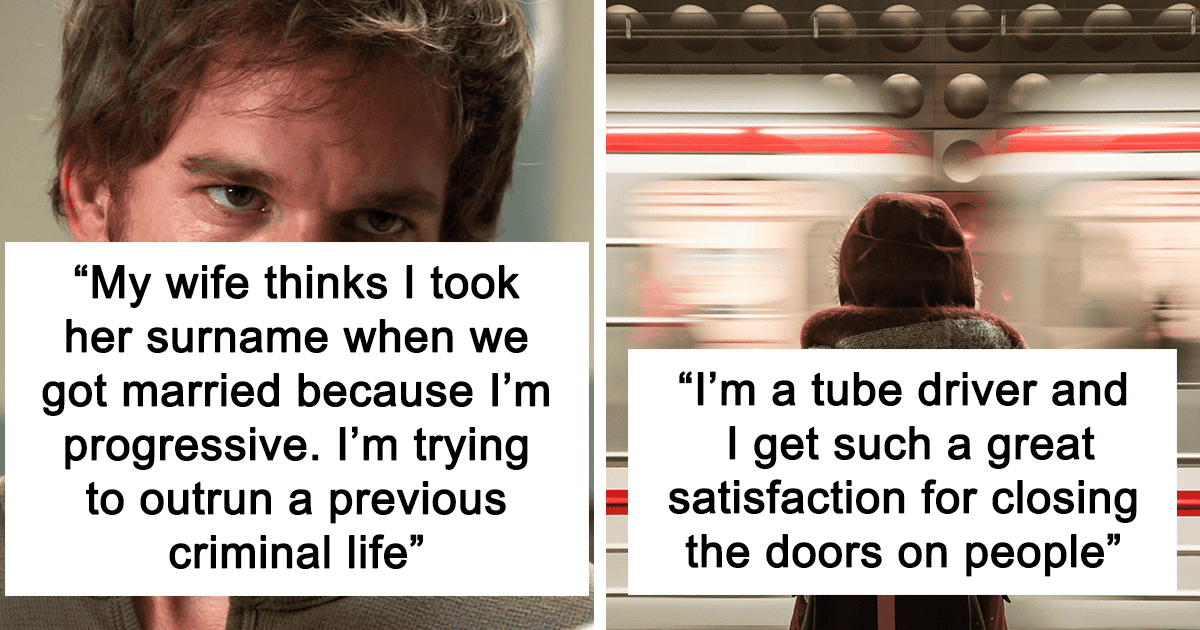
We at We compiled some of the wildest submissions ‘Fesshole’ has recently received, so put on your confessor hat (or pick up a scepter, whatever works for you), and continue scrolling to check out what some evil-doers have been up to.
For more, click on our older publications on ‘Fesshole’ here and here.
#1

#2

In The Secret Life of Secrets, Dr. Michael Slepian, the Sanford C. Bernstein & Co. Associate Professor of Leadership and Ethics at Columbia Business School, explained that we can draw a line between secrecy and privacy by considering secrecy as an intention to hold specific information back, and privacy as a reflection of how much we broadcast personal information, in general.
Generally, people who are more private require closeness before they let you in. Yet those who are less private may be happy to disclose personal information, not just to friends and family, but to coworkers, acquaintances, and even people they’ve just met as well.
You may not want to discuss your sexual experiences at work out of concern for privacy (and for what is appropriate), however, this is very different from wanting to keep some specific experience a secret. In both cases, you are taking control of your personal information, but for different reasons.
#3

#4

#5

“Aside from sex, money is another example of something you may not talk about but may not be intentionally keeping secret,” Slepian wrote. “You might not talk about your paycheck out of concern for privacy, rather than wanting nobody to ever know what it looks like.”
“At the same time, there may be other specifics you intend to keep hidden, such as a particularly unwise financial decision. These examples help us see that privacy and secrecy can coexist, and there can be gray area in between. So, can we ever really separate them? Yes, and the person who knows best—whether something is private or secret—is you.”
#6

#7

#8

#9

During his research, Slepian discovered that the more immoral we consider a personal experience or action, the more it feels like a secret, rather than something that is merely private.
He also found that the more we think others would find the information relevant to their own lives, the more something unsaid feels like secrecy instead of privacy.
#10

#11

#12

#13

He learned this from a study involving 1,000 participants in committed relationships. “I asked the participants to think about something they had not disclosed to their romantic partner,” the psychologist said.
“This was easy for them to do. We all have many such things, ranging from the consequential to the mundane. Some of the things people hadn’t disclosed were acts they considered highly immoral, like cheating on their partner and misrepresenting their past. The participants said that these felt very much like secrets. But other things did not seem immoral. For example, one participant told me he quite enjoys having the apartment to himself, and doesn’t mind when his partner is away for the weekend. In fact, it makes him quite happy.”
“Another participant told me that her partner doesn’t know how much she spends on yarn. These things didn’t feel like they mattered all that much, and so not mentioning them didn’t feel like keeping secrets,” Slepian noted.
#14

#15

#16

#17

Slepian said people are often wondering if they’re more secretive than the average person.
“When we start talking about tendencies for secrecy, we bump right up into personality psychology,” he said. “A common way of measuring personality is to ask about five broad traits: Openness (open to new experiences and to things being complicated), Conscientiousness (organized, disciplined), Extraversion (enthusiastic, social), Agreeableness (polite, eager to please), and Neuroticism (the less polite word for high negative emotion; many prefer to call this “low emotional stability” instead).”
(If you ever need to remember this information straight away just remember the acronym OCEAN.)
#18

#19


#21

“My research finds that someone who is more secretive (whether having had many experiences from the list or just a few) tends to be less extraverted and less emotionally stable, but more conscientious,” Slepian said.
Additionally, the profile of a person more likely to get involved in the kinds of situations that people keep secret is that of someone who is open, extraverted, and emotionally stable, but less agreeable and less conscientious.
#22

#23

#24

#25

#26

#27

#28

#29

#30

#31

#32

#33

#34

#35

#36

#37

#38

#39

#40

#41

#42

#43

#44

#45

#46

#47

#48

#49

#50
